Run your tongue along the inside of your cheek. That soft, slick surface is a cousin of the most important border in your body.
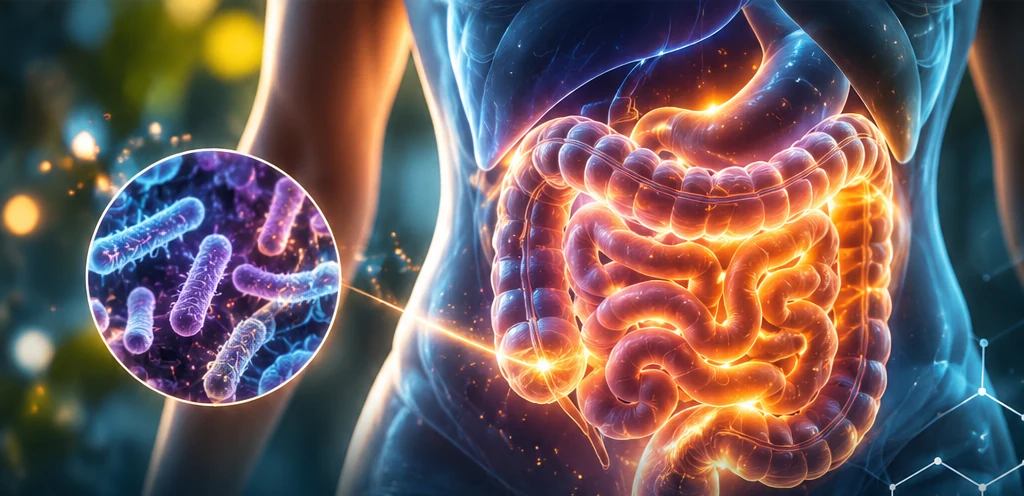
Inside your intestines, a lining just one cell thick separates you from everything you've eaten, and from trillions of bacteria. Spread flat, that lining would cover roughly 30 square meters, about the floor of a small apartment. Every day it makes countless decisions: let nutrients in, keep invaders out, and call for help only when the danger is real.
When that system works, you never think about it. When it doesn't, inflammation can take hold and refuse to leave. That stubborn fire is why a three-letter peptide called KPV has quietly become one of the most interesting molecules in gut research.
The thinnest wall in your body
Picture the gut lining as a wall of bricks with smart mortar. The bricks are intestinal cells. The mortar is made of protein seals called tight junctions, which decide what can slip between the cells.
In a healthy gut those seals hold firm, and the immune cells waiting just beneath the wall stay calm. When the barrier is damaged, bacterial fragments leak through, immune cells sound the alarm, and inflammation follows. That inflammation can weaken the barrier further, which lets even more through. Breaking this vicious cycle is one of the central goals of gut science.
When the alarm won't switch off
Inside many of the cells involved, the alarm runs through a master switch called NF-κB. When it flips on, cells pump out inflammatory messengers such as TNF-alpha and IL-6. That response is vital for fighting infection. The trouble starts when the switch gets stuck in the "on" position.
A fragment of a famous hormone
KPV's story begins with a hormone best known for tanning. Alpha-melanocyte-stimulating hormone, or alpha-MSH, is a chain of 13 amino acids that helps tell skin cells to make pigment. It turned out to have a second talent: calming inflammation. In the 1980s, researchers found that the hormone's last three amino acids alone could reduce fever in rabbits.
Those three amino acids are lysine, proline and valine. Their one-letter codes give the fragment its name: K, P, V. Dermatologists at Germany's University of Münster, reviewing two decades of work, described something remarkable. The tiny fragment kept most of alpha-MSH's anti-inflammatory power while losing its tanning effect, and in some experiments it was as strong as, or stronger than, the full hormone.
A molecule that small is simple to make and to study. Even better, it appears to calm inflammation partly through a route that doesn't rely on the receptors alpha-MSH normally uses.
The gut's own delivery door
Here's where the story gets clever. Your gut cells already have doors built for tiny peptides. One of them, a transporter called PepT1, normally works in the small intestine, absorbing fragments of digested protein. It's usually scarce in the colon, but in people with IBD it shows up in the inflamed colon lining.
CELL AND MOUSE STUDY In a 2008 study in Gastroenterology, researchers at Emory University showed that KPV walks right through that door. Inside intestinal and immune cells, even tiny amounts of KPV dampened the NF-κB switch and lowered inflammatory messengers. When mice with chemically induced colitis were given KPV by mouth, their colon inflammation eased.
In other words, the inflamed gut may build the very entrance KPV needs.
What the mouse studies found
Over the following decade, research groups in the United States and Europe tested KPV in animal models of colitis. The results pointed in the same direction.
MOUSE STUDY Faster recovery. In a 2008 German study, mice with two different types of colitis recovered faster, regained weight sooner and had fewer inflammatory cells in the colon when treated with KPV. The benefit held even in mice lacking alpha-MSH's main receptor.
MOUSE STUDY A smarter package. In 2010, scientists packed KPV into nanoparticles wrapped in a gel designed to dissolve in the colon. The targeted version matched the benefit of free KPV at a concentration 12,000 times lower.
MOUSE STUDY Healing, not just calming. A 2017 study coated those particles with hyaluronic acid to steer KPV toward inflamed colon cells. Treated mice showed both less inflammation and faster healing of the gut lining.
MOUSE STUDY A longer view. Chronic colitis raises the risk of colon cancer. In a 2016 study, KPV reduced colitis-associated tumor formation, but only in mice that had the PepT1 doorway.
Beyond the gut
LAB AND ANIMAL RESEARCH Because alpha-MSH was first studied in skin, researchers naturally looked there too. In laboratory studies of human skin cells, alpha-MSH-related peptides, including KPV's close relatives, suppressed NF-κB activation. The hormone and its tripeptide family have also calmed irritant and allergic skin inflammation in animal models.
RAT STUDY The mouth is another frontier. In a 2022 study, a KPV-loaded gel that clings to the gums reduced inflammation, fought bacteria and sped repair of chemotherapy-induced mouth sores in rats. It's an intriguing hint that KPV's influence may extend to other inflamed linings.
Where the human story stands
For all the promising lab and animal work, KPV itself has not yet been tested in a completed human clinical trial. That's the next chapter scientists are waiting for.
HUMAN TRIAL · RELATED COMPOUND There is one tantalizing clue from a cousin. PL8177, a different, lab-designed melanocortin peptide that targets the receptor alpha-MSH uses, was tested in a small Phase 2 trial in people with ulcerative colitis. According to the company's 2025 results, three of nine people who received it reached clinical remission after eight weeks, compared with none of three on placebo. The trial was tiny, and PL8177 works differently from KPV. Still, it suggests the melanocortin family's anti-inflammatory story may carry over to people.
The bottom line
KPV is a reminder that some of biology's most interesting tools hide in plain sight. Clip three amino acids off a tanning hormone and you get a molecule that, in the lab, slips through the gut's own doorways and turns down one of inflammation's master switches. Whether it can do the same in people is the big question its three letters still pose.
Next in PepJournal: Retatrutide, and why scientists are watching the rise of the triple-hormone approach to metabolism.