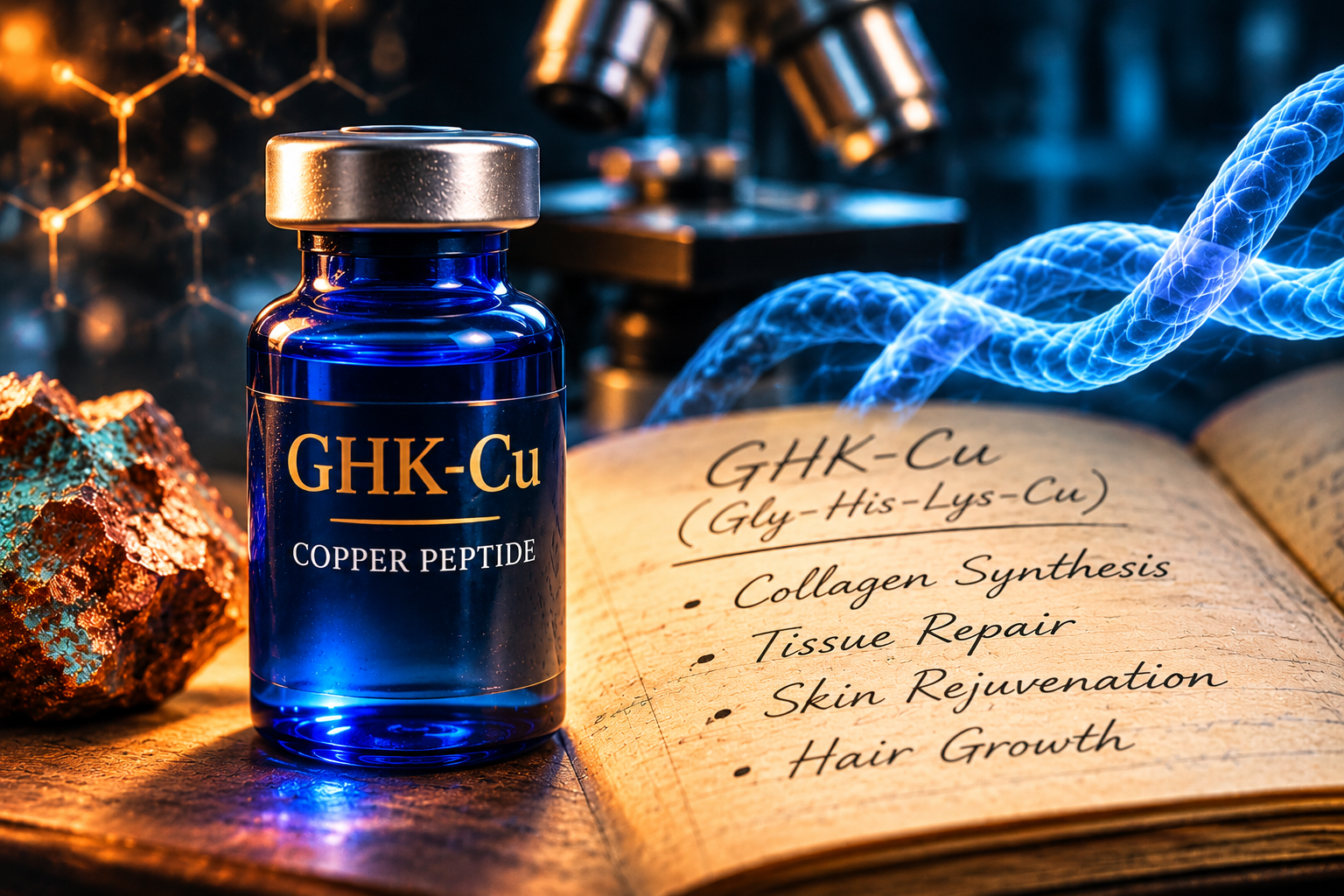
In the early 1970s, a graduate student at the University of California, San Francisco, was working on a question that sounds like science fiction: why does young tissue repair itself so much better than old tissue?
Loren Pickart tried a simple experiment. He took liver tissue from older people and bathed it in blood plasma from younger people. Something remarkable happened. The old tissue began producing proteins more typical of a much younger liver.
Something in young blood was sending a message. In 1973, Pickart tracked it down. It wasn't a large hormone or a complex protein. It was a tiny fragment made of just three amino acids: glycine, histidine, and lysine. Scientists named it GHK.
The molecule that fades
Here's the detail that made researchers sit up. GHK isn't evenly distributed across a lifetime. At age 20, a typical person carries about 200 nanograms of GHK in every milliliter of plasma. By age 60, that number has fallen to roughly 80 (Pickart & Margolina, 2018).
A quick note on names, since you'll see both. GHK is the peptide itself: three amino acids linked in a chain. GHK-Cu is that same peptide holding a single copper atom. The age figures above track GHK. But GHK latches onto copper so readily that in the body much of it is thought to travel in its copper-bound form, which is why the two names are so often used side by side.
That's a drop of about 60 percent, and it happens over the same decades when skin thins, wounds heal more slowly, and hair loses some of its density. Correlation isn't proof, of course. But it was enough to launch half a century of research into what this little molecule actually does.
Three amino acids and a copper atom
GHK has one standout talent: it grabs copper. It binds copper so eagerly that in the body it usually travels as a pair, GHK-Cu. Dissolve it in water and the solution turns a striking sapphire blue, which is why you'll sometimes see "blue copper peptide" on a skincare label.
Why would the body want a tiny copper courier? Because copper is quietly essential. About a dozen enzymes depend on it to do their jobs. One helps cells burn fuel for energy. Another is a frontline antioxidant that neutralizes damaging free radicals. And one is the
enzyme that cross-links collagen and elastin, the fibers that give skin its firmness and spring.
In 1980, Pickart and colleagues proposed in the journal Nature that GHK's job might be to help ferry copper into cells safely. Free copper can be harmful in the wrong place. Copper bound to GHK appears to be delivered in a gentler, more controlled way.
A message hidden inside collagen
In the 1980s, French researcher François-Xavier Maquart noticed something clever about where GHK comes from. Its three-letter sequence is built right into collagen itself.
That means when skin is injured and collagen gets broken down, GHK is released directly at the scene. Researchers proposed it may work like a first responder's flare: a signal that damage has happened and repair should begin.
In lab dishes, GHK-Cu prompted skin cells called fibroblasts to make more collagen, at vanishingly small concentrations. It also nudged production of elastin and other building blocks of healthy skin. Just as interesting, it seemed to fine-tune the enzymes that break down old, damaged collagen. Repair isn't only about building new material. It's also about clearing out the old.
What the skin studies show
This is where GHK-Cu moved out of the lab and onto people's faces. Several small clinical studies in women have tested copper-peptide creams on aging skin.
Facial skin: In a 12-week study of 71 women with sun-related skin aging, a GHK-Cu face cream was reported to increase skin density and thickness, reduce sagging, improve clarity, and soften fine lines (summarized here). Around the eyes: In 41 women, a GHK-Cu eye cream used for 12 weeks outperformed both a placebo and a vitamin K cream on lines, wrinkles, and skin thickness. Collagen head-to-head: In a small pilot comparison on thigh skin, collagen production improved in 70 percent of women using a GHK-Cu cream, versus 50 percent with vitamin C and 40 percent with retinoic acid. Wrinkle depth: A 2016 study involving 40 women reported reductions in wrinkle volume and depth with a GHK-Cu formulation compared with a control serum over eight weeks. The results were reported by the study authors and warrant interpretation in the context of a small cosmetics study.
These are modest-sized studies, many funded within the cosmetics world, so they're best read as encouraging rather than definitive. Still, the consistency of the results is a big reason GHK-Cu has become a fixture in serums and creams.
From wounds to hair follicles
Long before skincare brands took notice, wound researchers were studying GHK-Cu in animals.
In rabbits, topical copper peptide improved wound contraction and the growth of new tissue and blood vessels. In rats, collagen dressings carrying GHK sped healing, including in diabetic animals, whose wounds normally close slowly. In a 2003 study of ischemic wounds, those with poor blood supply, rats treated with GHK-Cu healed faster and showed lower levels of tissue-degrading enzymes and inflammatory signals.
Hair is the newer frontier. Copper peptides closely related to GHK-Cu enlarged hair follicles in rodent and primate studies in the 1990s, and GHK-Cu now appears in many scalp serums. Human data on hair remains limited, which makes it one of the more intriguing open questions in the field.
The gene-switch surprise
Then came the plot twist. In 2010, scientists began using the Broad Institute's Connectivity Map, a huge public database showing how more than 1,300 compounds change gene activity in human cells.
GHK turned out to be unusually busy. In those cell-line experiments, it shifted the activity of roughly 31 percent of the human genes measured by 50 percent or more, many of them tied to repair, antioxidant defense, and the cell's protein-recycling system.
The most striking example came from lung research. In a 2012 study published in Genome Medicine, scientists identified 127 genes linked to emphysema-related lung damage. When they searched the database for a compound that pushed those genes in the opposite direction, GHK came out on top. In the lab, it helped restore the ability of lung cells from COPD patients to rebuild their collagen scaffolding.
That finding comes from cells, not patients. But it reframed GHK-Cu as something potentially bigger than a skincare ingredient: a molecule that may help tell tissue to behave more like its younger self.
Why scientists keep coming back
GHK-Cu sits at a fascinating crossroads. It's natural, it's tiny, it fades with age, and it touches several of the processes that define how bodies age, from collagen and copper balance to inflammation and repair.
For skin, the human evidence is the strongest and most practical. For wounds, the animal evidence is rich. For hair, lungs, and gene expression, the story is still being written, and that's exactly what makes it worth watching.
About Suria Research Compounds
Suria PepJournal is published by Suria Research Compounds LLC, a supplier of research-use-only peptides for laboratory investigation. Every compound in our catalog is backed by batch-level testing documentation you can review yourself.
Explore the research catalog at suriacompounds.com.
Suria products are sold strictly for research and laboratory use and are not intended for human or animal consumption.
The takeaway
The molecule Loren Pickart pulled from young blood in 1973 turned out to be a tiny copper courier, a repair signal hidden inside collagen, and a surprisingly influential switch on human genes. Not bad for three amino acids.