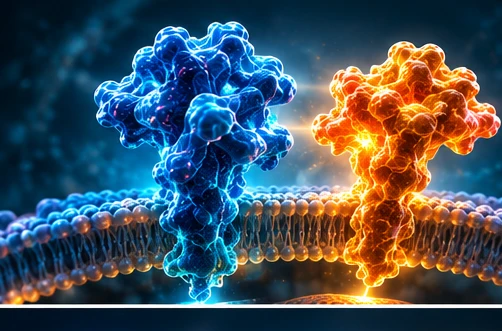
Scientists once dismissed one of the body's two meal hormones as the weaker partner. Pairing it with GLP-1 produced one of the most thoroughly studied molecules in metabolic medicine.
In the 1960s, researchers noticed something odd. Give a person sugar by mouth and their pancreas releases far more insulin than if the same amount of sugar goes straight into a vein. The gut, it turned out, was warning the pancreas that food was on its way.
That warning system, called the incretin effect, runs on two hormones: GLP-1 and GIP. For decades, GLP-1 got most of the attention. In people with type 2 diabetes, GIP's insulin signal seemed weak, so many researchers treated it as the less useful sibling. Tirzepatide was a bet that the sibling had been underrated. Its clinical trial program, among the largest in metabolic medicine, went on to test that bet in the liver, the airway, the heart and the kidneys.
Two signals, working as a team
Picture a two-person crew landing a plane. GLP-1 handles the throttle: it slows the stomach, quiets hunger in the brain and prompts insulin release when blood sugar rises. GIP is the co-pilot, also nudging insulin release and influencing how fat tissue handles incoming energy. Researchers are still working out how GIP affects appetite and nausea in the brain.
Tirzepatide is a single engineered peptide built on GIP's backbone and modified to also activate the GLP-1 receptor. One weekly dose lasts about a week.
Blood sugar: the first proving ground
Tirzepatide's research began with type 2 diabetes in the SURPASS program, a series of trials testing it against placebo and against established treatments.
PEER-REVIEWED · HEAD-TO-HEAD The most closely watched was SURPASS-2, published in NEJM in 2021. It put tirzepatide directly against semaglutide 1 mg in 1,879 adults with type 2 diabetes for 40 weeks. HbA1c fell by 2.01, 2.24 and 2.30 percentage points on the 5, 10 and 15 mg doses, versus 1.86 on semaglutide. All three tirzepatide doses lowered HbA1c significantly more than semaglutide. Weight loss was greater too: 7.6 to 11.2 kg, versus 5.7 kg.
Weight, and the road away from diabetes
PEER-REVIEWED · PHASE 3 In SURMOUNT-1 (NEJM, 2022), 2,539 adults with obesity but without diabetes took tirzepatide or placebo for 72 weeks. Average weight loss reached 15.0%, 19.5% and 20.9% on the three doses, versus 3.1% on placebo.
PEER-REVIEWED · 3-YEAR FOLLOW-UP The most medically meaningful result came later. Among 1,032 participants who started the trial with prediabetes, researchers kept treating and watching for three years. Only 1.3% of those on tirzepatide developed type 2 diabetes, compared with 13.3% on placebo, a hazard ratio of 0.07, or roughly 93% lower risk. When treatment stopped, some of the benefit faded: after 17 weeks off the drug, 2.4% had progressed, versus 13.7% on placebo, and participants regained some weight.
PEER-REVIEWED · HEAD-TO-HEAD In SURMOUNT-5 (NEJM, 2025), 751 adults with obesity were assigned to tirzepatide or semaglutide 2.4 mg for 72 weeks. Weight fell by 20.2% versus 13.7%, and waistlines shrank by 18.4 cm versus 13.0 cm.
The liver: from fat to scarring
Fatty liver disease often develops silently. Fat accumulates in liver cells (MASLD), the liver can become inflamed and injured (MASH), and over years scar tissue builds up (fibrosis). Each stage is measured differently, so each finding below answers a different question.
PEER-REVIEWED · MRI SUBSTUDY In SURPASS-3 MRI, 296 adults with type 2 diabetes had their liver fat measured by MRI before and after 52 weeks. Liver fat, starting at an average of about 15.7%, fell by 8.1 percentage points on the higher tirzepatide doses versus 3.4 on insulin degludec. The reductions tracked with shrinking belly fat.
PEER-REVIEWED · PHASE 2, BIOPSY SYNERGY-NASH (NEJM, 2024) went further, using liver biopsies to look at inflammation and scarring. It enrolled 190 adults with biopsy-confirmed MASH and moderate-to-advanced fibrosis (stage F2 or F3). After 52 weeks, MASH resolved without worsening of fibrosis in 44%, 56% and 62% of people on the three doses, compared with 10% on placebo. Fibrosis improved by at least one stage in 51% to 55% of the tirzepatide groups, versus 30% on placebo. The fibrosis analysis was secondary and smaller, but the direction was consistent.
SYNERGY-NASH was a mid-sized, one-year trial. Whether these changes prevent cirrhosis, liver cancer or liver failure over the long term is the question larger and longer studies are built to answer.
Sleep apnea: breathing through the night

PEER-REVIEWED · PHASE 3 SURMOUNT-OSA (NEJM, 2024) was a large trial built specifically around obstructive sleep apnea. It ran as two parallel studies of 469 adults with obesity and moderate-to-severe apnea: one for people not using a CPAP machine, one for people who were.
After 52 weeks, breathing interruptions fell by 25.3 events per hour with tirzepatide versus 5.3 with placebo in the first trial, and by 29.3 versus 5.5 in the second. Compared with placebo, that's roughly half of all interruptions eliminated. Sleep apnea-specific hypoxic burden, a measure of how deeply and how long oxygen levels drop, fell by 61% to 70% relative to placebo. Blood pressure and patient-reported sleep symptoms improved as well.
Oxygen dips during sleep strain the heart and blood vessels night after night, which is why researchers consider the hypoxic burden result especially meaningful.
The heart: two very different tests
PEER-REVIEWED · PHASE 3 SUMMIT (NEJM, 2024) studied 731 adults with obesity and a common, hard-to-treat form of heart failure called HFpEF, in which the heart pumps normally but has become stiff. Over a median of two years, cardiovascular death or worsening heart failure occurred in 9.9% on tirzepatide versus 15.3% on placebo, a 38% lower risk. Patients also reported meaningfully better symptoms and physical limitations on a standard heart failure questionnaire.
PEER-REVIEWED · HEAD-TO-HEAD OUTCOMES SURPASS-CVOT (NEJM, 2025) asked a harder question. Instead of placebo, it compared tirzepatide with dulaglutide, a GLP-1 medicine already shown to reduce heart events, in more than 13,000 adults with type 2 diabetes and existing cardiovascular disease, followed for a median of four years. Heart attack, stroke or cardiovascular death occurred in 12.2% on tirzepatide versus 13.1% on dulaglutide. That met the trial's test for non-inferiority but did not prove superiority. The topline results also reported 16% fewer deaths from any cause with tirzepatide.
Beating an active, heart-protective comparator is a high bar. What SURPASS-CVOT established is that tirzepatide protects the heart at least as well as a proven GLP-1 medicine, while lowering blood sugar and weight further.
The kidneys
PEER-REVIEWED · EXPLORATORY ANALYSIS Kidney findings so far come from analyses within larger trials rather than a completed kidney-focused trial. In SURPASS-4, which compared tirzepatide with insulin glargine in about 2,000 people with type 2 diabetes and high cardiovascular risk, a pre-specified exploratory analysis found a 42% lower risk of a combined kidney outcome, driven largely by fewer people developing heavy protein leakage into the urine.
In SURPASS-CVOT, a pre-specified analysis of people at high risk of kidney disease found that kidney function declined more slowly on tirzepatide than on dulaglutide over three years, with further exploratory kidney analyses published in 2026. These are encouraging signals that a dedicated kidney-outcomes trial would need to confirm.
Joints, movement and daily life
Weight loss on this scale should, in theory, take pressure off painful joints. Unlike semaglutide and retatrutide, though, tirzepatide has no published trial dedicated to knee osteoarthritis, so that question remains open. The clearest evidence for physical function comes from SUMMIT, where people with heart failure reported they could do more in daily life.
What about cancer?
Obesity is linked to at least 13 types of cancer, so a medicine that produces large weight loss naturally raises questions. No trial has measured whether tirzepatide prevents cancer, and there is no direct evidence that it does. A 2025 meta-analysis of 48 randomized trials, including tirzepatide in its sensitivity analyses, found these medicines likely have little or no effect on obesity-related cancer risk in either direction, with moderate-certainty evidence of no increased risk of thyroid or pancreatic cancer. In rodent studies, drugs in this family caused thyroid C-cell tumors; whether that applies to people hasn't been established, and researchers continue to monitor it.
The trade-offs
The most common side effects are digestive: nausea, diarrhea, vomiting and constipation, usually mild to moderate and clustered around dose increases. In SURMOUNT-OSA, nausea affected about 24% of people on tirzepatide versus 8% on placebo. In the four-year SURPASS-CVOT trial, 13.2% stopped tirzepatide because of side effects, compared with 10.1% on dulaglutide.
The power of two
Tirzepatide's research story is unusual for its breadth. Within a few years, the same molecule was tested in diabetes, obesity, prediabetes, fatty liver disease, sleep apnea, heart failure and cardiovascular outcomes, often with results that went well beyond weight.
It also showed that the once-overlooked hormone deserved a second look. Exactly how much GIP contributes, compared with GLP-1 alone, is still being untangled. But the two signals together reshaped how scientists think about treating metabolism, and opened the door to adding a third.
About Suria Research Compounds
Suria PepJournal is published by Suria Research Compounds LLC, a supplier of research-use-only peptides for laboratory investigation. Every compound in our catalog is backed by batch-level testing documentation you can review yourself.
Explore the Suria research catalog
Suria products are sold strictly for research and laboratory use and are not intended for human or animal consumption.
Next in PepJournal: One signal, two signals, three. How do semaglutide, tirzepatide and retatrutide really compare, and what can the evidence actually tell us? One, Two, Three: The Evolution of Metabolic Medicine.