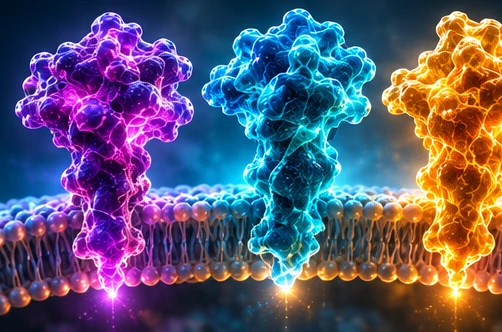
Semaglutide speaks to one hormone receptor, tirzepatide to two, retatrutide to three. Here's what each approach has shown, how strong the evidence is, and why counting receptors doesn't crown a winner.
The story begins with a lizard. In the early 1990s, scientists studying the venom of the Gila monster found a molecule that mimicked GLP-1, the gut hormone that tells the pancreas to release insulin and the brain that a meal has arrived. Human GLP-1 vanishes from the blood within minutes. The lizard's version lasted for hours.
That discovery launched a scientific relay race. Each generation of molecules lasted longer, did more, and was tested in more parts of the body. Three of them now anchor the field: semaglutide, tirzepatide and retatrutide. They're often described as one, two and three, for the number of hormone receptors each one activates. The numbers are real. What they mean is more interesting than "more is better."
Three keys, three sets of locks
Imagine the body's metabolism as a building with many doors. Each hormone is a key that opens a specific lock, called a receptor, and each opened door starts a different process.
• Semaglutide (one key: GLP-1). Slows stomach emptying, quiets appetite, and boosts insulin when blood sugar is high.
• Tirzepatide (two keys: GLP-1 and GIP). Adds GIP, a second meal hormone that also boosts insulin and influences how fat tissue stores energy.
• Retatrutide (three keys: GLP-1, GIP and glucagon). Adds glucagon, which tells the liver to burn stored fat and appears to raise the energy the body spends.
Each new key opens new doors, but every door opened also brings its own effects, wanted and unwanted. That's why each molecule has to be tested on its own merits.
A rule worth knowing before comparing
It's tempting to line up each drug's best weight-loss number and declare a ranking. Scientists don't, for a simple reason: trials differ. They enroll different people, run for different lengths of time, use different doses and count dropouts differently. A 25% result in one trial and a 20% result in another aren't a fair fight.
The only fair fight is a head-to-head trial, where both drugs are tested in the same people at the same time. Those trials exist for semaglutide and tirzepatide. For retatrutide, no published trial has yet compared it directly with either one.
The head-to-head evidence
PEER-REVIEWED · HEAD-TO-HEAD SURPASS-2 (2021) compared tirzepatide with semaglutide 1 mg in 1,879 adults with type 2 diabetes. After 40 weeks, all three tirzepatide doses lowered HbA1c more (by 2.01 to 2.30 percentage points, versus 1.86) and produced more weight loss.
PEER-REVIEWED · HEAD-TO-HEAD SURMOUNT-5 (2025) compared the two at their obesity doses in 751 adults without diabetes. After 72 weeks, weight fell by 20.2% on tirzepatide and 13.7% on semaglutide.
These trials answer the weight and blood sugar questions directly for these two drugs, at these doses, in these populations. They don't tell us which drug better protects the heart, liver or kidneys, because they weren't designed to measure that.
Weight: three trials, three answers
Each drug's flagship placebo-controlled trial produced a different headline number: about 15% for semaglutide in STEP 1 (68 weeks), about 21% at the top tirzepatide dose in SURMOUNT-1 (72 weeks), and 25% at the top retatrutide dose in TRIUMPH-1 (80 weeks). Each was measured against its own placebo group, over different lengths of time. They show the scale of each molecule's effect, not a ranking.
The heart

PEER-REVIEWED · OUTCOMES Semaglutide has the most direct cardiovascular evidence. In SELECT (2023), 17,604 adults with heart disease and overweight but no diabetes had 20% fewer heart attacks, strokes and cardiovascular deaths over about three years than on placebo.
Tirzepatide's evidence takes a different shape. SUMMIT found 38% fewer cardiovascular deaths or heart failure events in people with obesity and HFpEF. SURPASS-CVOT showed it was at least as protective as dulaglutide, an established heart-protective medicine, over four years.
Retatrutide has lowered blood pressure, triglycerides and inflammation markers, but its cardiovascular outcome trial is still underway. For now, its heart story is about risk factors, not proven events.
The liver
PEER-REVIEWED Here the evidence ladder is especially clear. Semaglutide's ESSENCE trial, a large Phase 3 study of 800 people with MASH and moderate-to-advanced scarring, found MASH resolved without worsening fibrosis in 62.9% after 72 weeks, versus 34.3% on placebo. Scarring improved in 36.8% versus 22.4%. Tirzepatide's SYNERGY-NASH, a smaller Phase 2 biopsy trial, found MASH resolution in up to 62% versus 10% over 52 weeks. Retatrutide's data so far are MRI measurements: an 86% average drop in liver fat on the highest dose in a Phase 2 substudy. That's a dramatic fat result, but not yet a biopsy result.
Sleep apnea, kidneys and knees
Sleep apnea. Both tirzepatide (SURMOUNT-OSA) and retatrutide (TRIUMPH-1-OSA and TRIUMPH-2-OSA) have large randomized trials showing major cuts in breathing interruptions. Semaglutide's sleep apnea evidence is more limited, with no dedicated trial of comparable size in this review.
Kidneys. Semaglutide's FLOW trial is the standout: in 3,533 people with type 2 diabetes and chronic kidney disease, a combined measure of kidney failure, major loss of kidney function, or death from kidney or cardiovascular causes fell by 24%. For tirzepatide, kidney benefits come from exploratory analyses within larger trials. For retatrutide, an early study found less protein leakage in the urine, a promising but preliminary signal.
Knees. Semaglutide's STEP 9 trial of 407 people with knee osteoarthritis found significantly greater pain relief than placebo. Retatrutide's TRIUMPH-4 reported about 75% pain reduction in company-released results, backed by a peer-reviewed knee group within TRIUMPH-1. Tirzepatide hasn't had a dedicated knee trial.
Cancer: what the evidence can and can't say
Because obesity raises the risk of many cancers, researchers are watching closely. None of these three drugs has been shown in a randomized trial to prevent cancer. A large 2024 observational study of 1.6 million people with type 2 diabetes linked GLP-1 medicines, mostly older ones, to lower rates of several obesity-associated cancers compared with insulin. But no such link appeared when GLP-1 medicines were compared with metformin, and observational studies can't prove cause and effect.
On safety, a 2025 meta-analysis of 48 randomized trials found single- and dual-receptor drugs likely have little or no effect on obesity-related cancer risk, with moderate-certainty evidence of no increased risk of thyroid or pancreatic cancer. Retatrutide hasn't been studied enough to say anything either way.
Side effects: a shared signature

All three share a digestive signature: nausea, diarrhea, vomiting and constipation, usually mild to moderate and most common while the dose is being increased. In the head-to-head SURMOUNT-5 trial, fewer people stopped tirzepatide than semaglutide because of digestive side effects (2.7% versus 5.6%). Retatrutide trials have also reported dysesthesia, an unusual skin sensation that was more common at higher doses. At its highest dose in TRIUMPH-1, about 11% stopped treatment because of side effects, versus about 5% on placebo.
At a glance
Read each row across, not as a ranking. Results come from different trials unless marked head-to-head.
Semaglutide Tirzepatide Retatrutide
Receptors GLP-1 GLP-1 + GIP GLP-1 + GIP + glucagon
Weight (flagship trial)
−14.9% vs −2.4%, 68 wk (STEP 1)
RCT
−20.9% vs −3.1%, 72 wk (SURMOUNT-1)
RCT
−25.0% vs −3.9%, 80 wk (TRIUMPH-1)
RCT
Head-to-head Less weight loss and HbA1c reduction than tirzepatide (SURPASS-2, SURMOUNT-5)
HEAD-TO-HEAD RCT
More weight loss and HbA1c reduction than semaglutide
HEAD-TO-HEAD RCT
No published head-to-head trial
EVIDENCE LACKING
Blood sugar Established in type 2 diabetes trials
RCT
SURPASS program incl. 3-year diabetes prevention
RCT
Phase 2 trial; Phase 3 company-reported
RCT, PARTLY COMPANY-REPORTED
Liver MASH resolution and fibrosis improvement (ESSENCE, Phase 3)
RCT · BIOPSY
MASH resolution; fibrosis signal (SYNERGY-NASH, Phase 2)
RCT · BIOPSY
Liver fat −86% by MRI (Phase 2)
EARLY HUMAN · IMAGING
Sleep apnea No dedicated large trial in this review
LIMITED
AHI cut by ~half vs placebo (SURMOUNT-OSA)
RCT
AHI −22 to −24/hr vs placebo without diabetes; smaller in diabetes trial
RCT
Heart 20% fewer heart attacks, strokes, CV deaths (SELECT)
RCT · OUTCOMES
Fewer HF events (SUMMIT); non-inferior to dulaglutide (SURPASS-CVOT)
RCT · OUTCOMES
Risk factors improve; outcome trial underway
RISK FACTORS ONLY
Kidneys 24% fewer major kidney events (FLOW)
RCT · PRIMARY OUTCOME
Lower kidney risk in exploratory analyses
RCT · EXPLORATORY
Albuminuria −54% vs −9% (Phase 2b)
EARLY HUMAN · CONFERENCE
Knee OA Pain improved vs placebo (STEP 9)
RCT
No dedicated trial
EVIDENCE LACKING
Pain down ~75% (TRIUMPH-4); TRIUMPH-1 knee group
RCT, PARTLY COMPANY-REPORTED
Cancer No prevention evidence; observational links
OBSERVATIONAL · META-ANALYSIS
No prevention evidence; no increased risk seen
META-ANALYSIS
No meaningful evidence yet
EVIDENCE LACKING
Common side effects
Digestive Digestive Digestive; dysesthesia
Why three isn't automatically better
If adding receptors simply added benefits, the story would be easy. Biology is less tidy. Each receptor brings trade-offs, and the right balance may depend on the person and the problem: someone with severe fatty liver disease, someone with heart disease and someone with knee pain may each be best served by different evidence.
What's undeniable is the trajectory. In a little over three decades, a curiosity from lizard venom has grown into a family of molecules being studied for the liver, the airway, the heart, the kidneys and the joints. One, two, three is not a scoreboard. It's a record of how scientists learned to speak more of the body's metabolic language, and the conversation is far from over.
About Suria Research Compounds
Suria PepJournal is published by Suria Research Compounds LLC, a supplier of research-use-only peptides for laboratory investigation. Every compound in our catalog is backed by batch-level testing documentation you can review yourself.
Explore the Suria research catalog
Suria products are sold strictly for research and laboratory use and are not intended for human or animal consumption.
Next in PepJournal: Inside nearly every cell is a microscopic power plant. SS-31, MOTS-c and NAD+ take three very different paths to cellular energy. The Mitochondria Mystery.