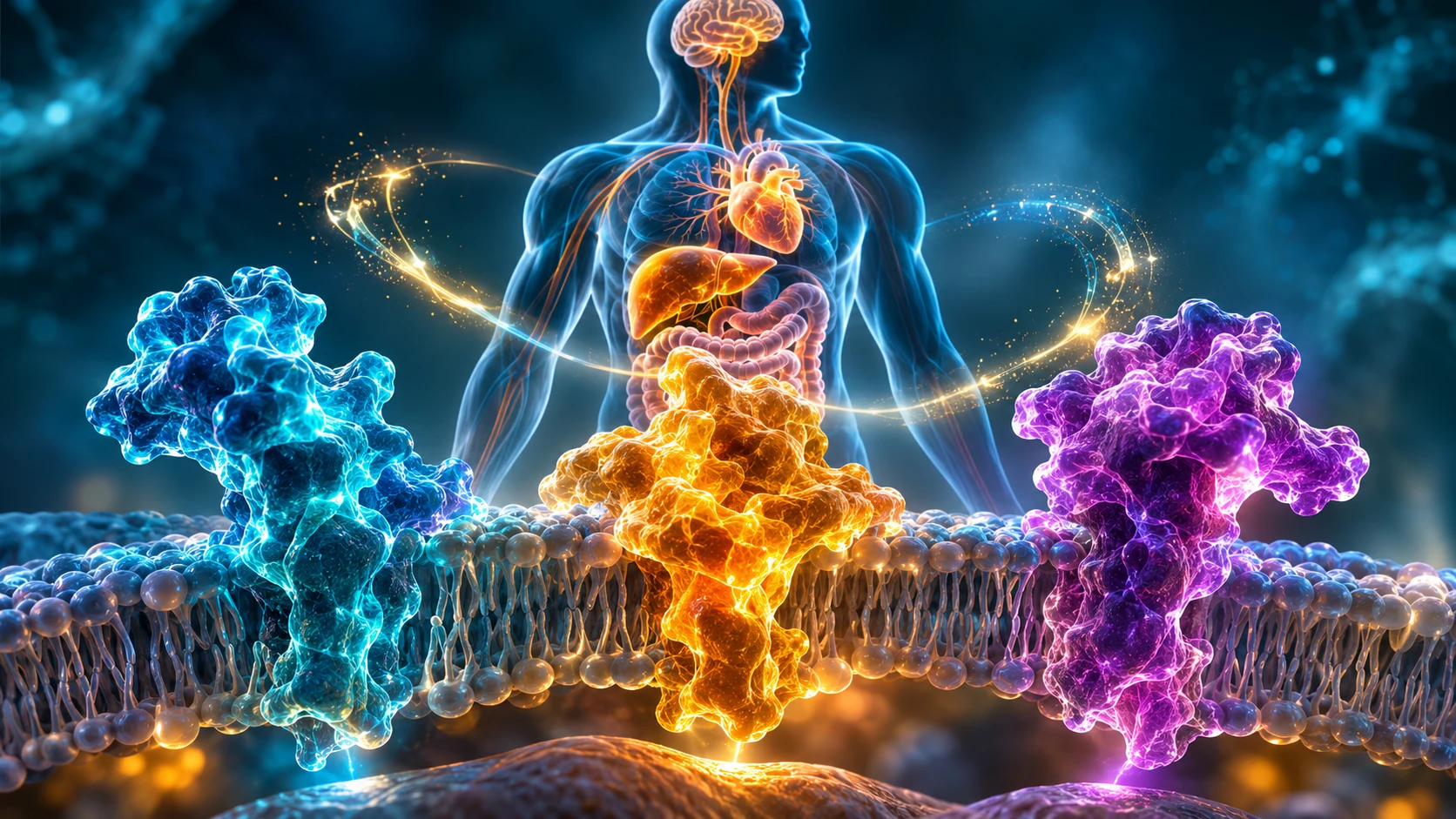
One engineered molecule, three of the body's metabolic signals. Inside the clinical research that tested retatrutide on weight, the liver, sleep, joints, blood sugar and the heart.
Every time you eat, your gut starts a conversation. Within minutes, hormones stream from the intestine and pancreas into the blood, carrying messages to the brain, the liver, fat tissue and the pancreas itself: food has arrived, release insulin, you can stop eating soon.
Three of those messengers matter most to this story. Scientists have studied each of them for decades, mostly one at a time. Retatrutide was designed to speak all three languages at once, and the clinical trials testing it have produced some of the most striking numbers in metabolic research. But the most interesting findings aren't on the bathroom scale. They're in the liver, the airway, the knees and the kidneys.
Three messengers, one molecule
Think of metabolism as a sound engineer's mixing desk. Each of these hormones is a slider, and each pushes the body in a different direction.
• GLP-1 is the brake. It tells the brain you're full, slows how fast the stomach empties, and prompts the pancreas to release insulin when blood sugar rises. It's the signal behind the first generation of modern metabolic medicines.
• GIP is the co-pilot. Released alongside GLP-1 after a meal, it also boosts insulin release and influences how fat tissue stores energy. Researchers are still mapping its role in appetite.
• Glucagon is the furnace. Best known for raising blood sugar between meals, it also tells the liver to burn stored fat and appears to increase the energy the body spends at rest.
On its own, glucagon's sugar-raising effect would be a problem. The idea behind retatrutide is that the GLP-1 and GIP signals counterbalance it, leaving the potential benefits of glucagon, especially its effects on liver fat and energy use, free to work. Retatrutide is a single engineered peptide, modified so one weekly dose lasts about a week in the body.
The weight results
PEER-REVIEWED · PHASE 2 The first major test came in a 2023 study in NEJM. Among 338 adults with obesity, those on the highest dose (12 mg) lost an average of 24.2% of their body weight over 48 weeks, compared with 2.1% on placebo. Weight was still falling when the study ended.
PEER-REVIEWED · PHASE 3 The larger TRIUMPH-1 trial, published in NEJM in 2026, followed 2,339 adults for 80 weeks. Average weight loss was 17.6%, 23.7% and 25.0% on the 4, 9 and 12 mg doses, versus 3.9% on placebo. In a company-reported extension, people with a starting BMI of 35 or more who moved to their highest tolerated dose reached reductions of up to about 30% at 104 weeks.
Those numbers tell only part of the story. TRIUMPH-1 was built with "baskets," smaller groups of participants with specific health conditions, so researchers could ask what the weight loss means for the body's organs.
The liver: clearing out the fat
Fat, inflammation, scarring: four different questions
Liver fat (MASLD). Fat builds up inside liver cells. It's measured by MRI scan.
MASH. The fatty liver becomes inflamed and its cells are injured. Confirming it requires a biopsy.
Fibrosis. Ongoing injury leaves scar tissue, staged from F0 (none) to F4 (cirrhosis). Also judged by biopsy.
Long-term outcomes. Liver failure, liver cancer, transplant. These take years of follow-up to measure.
Reducing fat is the first step, but it doesn't automatically prove the later stages improve.
PEER-REVIEWED · PHASE 2 SUBSTUDY Glucagon's link to liver fat made the liver an obvious place to look. In a 2024 analysis in Nature Medicine, researchers used MRI to track 98 participants from the Phase 2 trial who started with substantial liver fat. After 24 weeks on 12 mg, liver fat fell by an average of 82.4%. By 48 weeks, the drop reached 86%, and 93% of people on that dose had liver fat back in the normal range, below 5%. Placebo barely moved.
The reductions tracked closely with weight loss and with improvements in insulin sensitivity and blood fats. Researchers suspect glucagon's direct action on the liver adds to the effect, but that remains a hypothesis. These were measurements of fat, not biopsies, so whether retatrutide resolves inflammation or reverses scarring is a separate question that requires separate trials.
Sleep apnea: more breaths, fewer pauses
In obstructive sleep apnea, the airway repeatedly narrows or collapses during sleep. Each pause starves the body of oxygen and jolts the sleeper toward waking, often without them knowing it. Severity is measured by the apnea-hypopnea index (AHI), the number of breathing interruptions per hour. Thirty or more counts as severe.
PEER-REVIEWED · PHASE 3 Two trials published in NEJM in 2026 tested retatrutide in adults with moderate-to-severe sleep apnea over 80 weeks. In TRIUMPH-1-OSA (243 people without diabetes), AHI fell by 34.3 events per hour on 9 mg and 31.7 on 12 mg, compared with 9.9 on placebo. In TRIUMPH-2-OSA (448 people with type 2 diabetes), it fell by 24.7 and 25.4, compared with 10.3.
In plain terms, someone whose breathing stalled once every minute or two could see dozens fewer interruptions every hour of the night. Weight loss reduces fat around the airway, the most likely explanation, though the trials weren't designed to separate weight effects from other mechanisms.
Knees: relief for the joints that carry the load
Every extra pound of body weight multiplies the force on the knees with each step. That made knee osteoarthritis a natural test of whether weight loss translates into daily function.
COMPANY-REPORTED · PHASE 3 In TRIUMPH-4, 445 adults with obesity and knee osteoarthritis took retatrutide or placebo for 68 weeks. Those staying on 12 mg lost an average of 28.7% of their body weight, versus 2.1% on placebo. On the WOMAC pain scale, pain fell by roughly 75% on either dose, compared with about 40% on placebo. In a post-hoc look, about one in eight people on 12 mg reported no knee pain at all by the end, compared with 4% on placebo.
The knee group inside the peer-reviewed TRIUMPH-1 trial also showed significantly greater pain reduction than placebo. Inflammation markers such as hsCRP fell too. Whether the relief comes purely from lighter joints, from calmer inflammation, or both is still being studied.
Blood sugar: from prediction to proof
PEER-REVIEWED · PHASE 2 A 2023 trial in The Lancet of 281 adults with type 2 diabetes found HbA1c, the three-month average of blood sugar, fell by up to about 2 percentage points over 36 weeks.
COMPANY-REPORTED · PHASE 3 The first large diabetes trial, TRANSCEND-T2D-1, enrolled 537 adults with early type 2 diabetes and a starting HbA1c of 7.9%. After 40 weeks, HbA1c fell by 1.7 to 2.0 points across the three doses, versus 0.8 on placebo. Weight fell by up to 16.8%, and was still falling at week 40.
The kidneys: lowering the pressure
CONFERENCE-PRESENTED · PHASE 2B Kidney filters, called glomeruli, can be damaged by years of high pressure inside them. In TRANSCEND-CKD, presented in 2026, researchers studied 146 adults with obesity and chronic kidney disease for 24 weeks. The main measurement, directly measured filtration rate, didn't change significantly compared with placebo.
Other signals were intriguing. Among people who started with protein leaking into their urine, an early warning sign of kidney damage, that leakage fell by 53.7% on retatrutide versus 8.8% on placebo. Estimated pressure inside the filters dropped, and the fat surrounding the kidneys shrank by 16%. Researchers interpret this pattern as a possible sign of long-term kidney protection. That's a hypothesis, and it will take larger, longer studies to test.
Heart and metabolism: the risk factors move
Across the trials, retatrutide lowered several of the numbers doctors use to estimate cardiovascular risk. In TRIUMPH-4, systolic blood pressure fell by about 14 points on 12 mg, and triglycerides, non-HDL cholesterol and inflammation markers improved. Heart rate rose modestly, a known effect of this drug class that researchers continue to monitor.
Improving risk factors is not the same as preventing heart attacks or strokes. That question belongs to TRIUMPH-Outcomes, a large trial designed to measure cardiovascular and kidney events directly.
What about cancer?
Obesity raises the risk of at least 13 types of cancer, which naturally prompts the question. For retatrutide specifically, there is no meaningful direct evidence either way: no trial has measured cancer outcomes. A 2025 meta-analysis of 48 randomized trials of single- and dual-receptor drugs in this family found they likely have little or no effect on obesity-related cancer risk, but those findings can't simply be transferred to a triple-receptor molecule.
The trade-offs
Like other medicines in this family, retatrutide's most common side effects were digestive. In TRIUMPH-1, about 42% of people on the highest dose reported nausea at some point, mostly mild to moderate and concentrated during dose increases. About 11% on 12 mg stopped treatment because of side effects, compared with about 5% on placebo. Trials also reported dysesthesia, an unusual skin sensation, which was more common at higher doses and usually mild.
Why three signals?
It's tempting to assume three signals must beat two, and two must beat one. Science doesn't work that way. Each added pathway brings its own benefits and its own side effects, and only direct comparisons in the same trial can show which approach works best for which outcome.
What retatrutide's research has already shown is that turning three dials at once can reshape far more than body weight. The liver emptied of fat, airways that stayed open at night, knees that hurt less. Each finding opens a new question, and that's what makes this molecule one of the most closely watched stories in metabolic science.
About Suria Research Compounds
Suria PepJournal is published by Suria Research Compounds LLC, a supplier of research-use-only peptides for laboratory investigation. Every compound in our catalog is backed by batch-level testing documentation you can review yourself.
Explore the Suria research catalog
Suria products are sold strictly for research and laboratory use and are not intended for human or animal consumption.
Next in PepJournal: Before three signals, there were two. Tirzepatide paired GLP-1 with GIP, and its research program reached from the liver to the heart. Tirzepatide: The Power of Two.